




Last Updated: November 2, 2026
Quick Summary
Pattern hair loss is a progressive, nonscarring form of hair thinning driven by genetics and hormone sensitivity, in which hair follicles gradually shrink and produce finer, shorter hairs over time. It is the most common form of hereditary-patterned baldness in both sexes, and DHT affects only follicles with a genetic sensitivity to it.
- Follicular miniaturization shrinks the follicle so each growth cycle delivers a thinner hair shaft.
- The Norwood scale grades male pattern baldness, while the Ludwig and Savin scales grade female pattern loss.
- Female pattern loss usually shows as central thinning with a widening part and an intact frontal hairline.
- Diagnosis is clinical, working through history, pattern mapping, trichoscopy, and targeted testing when needed.
- Every evidence-based treatment requires continued use, and stopping typically returns you to your baseline pattern within months.
Table of Contents
- Pattern Hair Loss: What It Actually Is
- Pattern Hair Loss Symptoms and Signs to Watch For
- Stages of Hair Loss: Reading the Norwood, Ludwig, and Savin Scales
- Pattern Hair Loss in Females: Central Thinning and Part Widening
- How Pattern Hair Loss Is Diagnosed
- Pattern Hair Loss Treatment Options and What the Evidence Shows
- Realistic Timelines, Maintenance, and Quality of Life
- Building a Hair Wellness Routine with FLOTE RADIANCE
- Frequently Asked Questions
Pattern Hair Loss: What It Actually Is
Pattern hair loss is a progressive, nonscarring form of hair thinning driven by genetics and hormone sensitivity, in which hair follicles gradually shrink and produce finer, shorter hairs over time. A clinical review in the Cleveland Clinic Journal of Medicine describes the process as gradual loss of terminal hair through follicular miniaturization, rather than scarring of the scalp. At FLOTE LABS, we explain it this way because the mechanism matters: you are not "losing" hair so much as growing weaker hair each cycle.
That distinction changes everything about how you treat it. Below, we break down what pattern hair loss actually is, how it is diagnosed, what the evidence says about treatment, and what a realistic timeline looks like.
Androgenetic Alopecia and the Role of DHT
Androgenetic alopecia is the medical term for pattern hair loss, and it is the most common form of hereditary-patterned baldness in both sexes (Treatment options for androgenetic alopecia). The driver is a combination of genetic predisposition and androgens, chiefly dihydrotestosterone (DHT). DHT does not attack every follicle equally. It affects follicles that carry a genetic sensitivity to it, which is why loss follows a predictable pattern rather than spreading evenly across the scalp.
Hormone sensitivity, not raw hormone levels, explains most of the variation between people. Two adults with similar DHT levels can have very different hair density because their follicles respond differently. If you want to understand whether DHT-blocking botanicals are worth your money, our guide to Saw Palmetto for Hair Loss covers what the extract actually does and how potency varies between products.
Follicular Miniaturization: Why Hairs Get Thinner
Follicular miniaturization is the shrinking of the hair follicle itself, which produces progressively finer, shorter hairs until the follicle stops producing visible terminal hair. Each growth cycle delivers a slightly thinner hair shaft, and the anagen phase shortens while more follicles sit in the telogen phase. What you see in the mirror is the cumulative result: vellus hair replacing terminal hair, and hair density dropping across the affected area.
Pattern Hair Loss Symptoms and Signs to Watch For
The earliest sign is usually a change in texture and density rather than visible baldness. Common pattern hair loss symptoms include a widening part, a receding hairline, thinning at the crown, and more scalp visible under direct light. Shedding counts often stay normal, which is why many people miss the onset for years.
Watch for these signals:
- Hairs that feel finer and shorter in one specific zone
- A part line that has widened by a noticeable margin
- Increased scalp visibility at the crown or temples
- Family history of thinning on either side
- Gradual change over months, not sudden shedding
Sudden, diffuse shedding is a different picture and warrants a clinical workup.
Stages of Hair Loss: Reading the Norwood, Ludwig, and Savin Scales
Clinicians grade progression using standardized scales, and knowing which one applies to you makes treatment conversations far more productive. The Norwood scale classifies male pattern baldness from minimal recession through extensive crown and hairline loss. The Ludwig scale grades female pattern hair loss by degree of central part widening, and the Savin scale offers a finer-grained version of the same idea.
| Scale | Used For | What It Grades | Practical Use |
|---|---|---|---|
| Norwood | Male pattern baldness | Hairline recession and crown loss, stages I-VII | Tracking whether loss is advancing |
| Ludwig | Female pattern hair loss | Central part widening, grades I-III | Baseline for treatment response |
| Savin | Female pattern hair loss | Finer central-density grading | Detecting subtle early change |
Photograph your scalp under the same lighting monthly. It is the simplest way to see whether your stage is holding or advancing.
Pattern Hair Loss in Females: Central Thinning and Part Widening
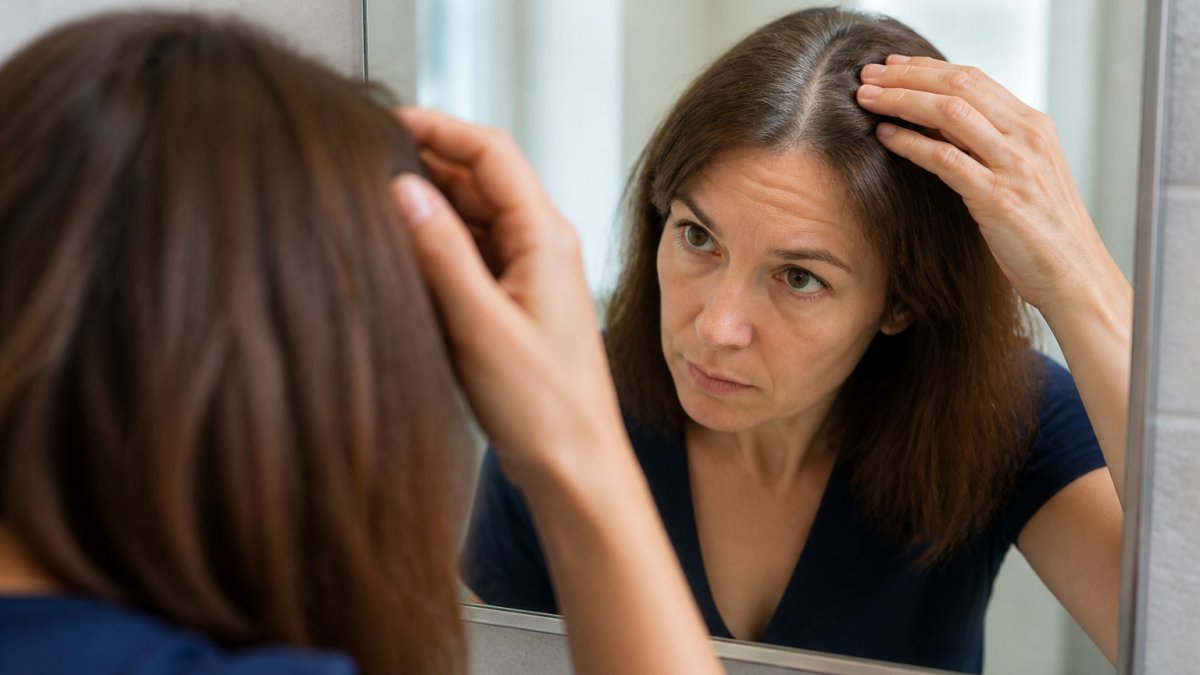
Pattern hair loss in females typically presents as diffuse thinning across the central scalp with a widening part, while the frontal hairline often stays intact. The Ludwig scale grades this from mild part widening (grade I) through noticeable central thinning (grade II) to severe diffuse loss with retained frontal hairline (grade III); the Savin scale adds finer gradations for detecting early change. A 2023 review notes that the exact cause is not fully established, which is an important caveat: female pattern hair loss is a described pattern, not a single proven pathway. Prevalence increases with advancing age, according to a review of female pattern hair loss treatment concepts.
Why the workup differs. Because female-pattern thinning overlaps with several reversible causes, most practitioners do not diagnose on appearance alone. Thyroid disease, iron deficiency (low ferritin), postpartum hormonal shifts, and polycystic ovary syndrome can mimic or compound the pattern.
Treatment eligibility is not the same as for men.
Inclusive guidance. Presentation and treatment considerations can differ for transgender and nonbinary people and for people using hormone therapy. Because eligibility for finasteride and spironolactone depends on pregnancy potential and hormone regimen, the treatment conversation should be individualized with a clinician who knows your full medication and hormone history rather than defaulting to a male or female template.
What to track. Photograph your part under the same lighting monthly, measure part width at a fixed point, and note shedding on wash day. Bring those records to your appointment, they are more useful than a verbal description and help distinguish patterned progression from a shedding episode. For a broader practical overview, our article on 8 Things to Know About Hair Growth for Women covers the daily habits that support density.
FLOTE RADIANCE — Hair Growth Oral Blend →
How Pattern Hair Loss Is Diagnosed
Diagnosis is clinical, and most cases do not require a biopsy, but the pathway is more structured than "look at the scalp and guess." A clinician typically works through four steps: history, pattern mapping, trichoscopy, and targeted testing only when the picture is ambiguous. Knowing what each step is for helps you ask better questions and avoid both under- and over-testing.
Step 1: Focused history. Age of onset matters. Pattern hair loss usually begins gradually in the teens to thirties in men and often later, around perimenopause, in women, whereas loss that starts within weeks of a major stressor, illness, childbirth, or a new medication points toward telogen effluvium. The clinician will ask about family history on both sides, shedding volume (a rough count of hairs lost on wash day is more useful than a vague impression), recent weight change, restrictive diets, thyroid symptoms, and any hormonal therapy. Bring a list of every medication and supplement, including over-the-counter pain relievers and protein powders.
Step 2: Pattern mapping. Patterned thinning follows recognizable distributions. In men, recession at the temples and thinning at the crown; in women, widening of the central part with relative sparing of the frontal hairline. A clinician often measures part width at a fixed point and compares it to a prior photo or a baseline measurement. Diffuse thinning that crosses pattern boundaries, or loss that is patchy, is a signal to look for another cause.
Step 3: Trichoscopy. A handheld magnifier or dermatoscope lets the clinician measure hair shaft diameter variation. Trichoscopy also helps rule out competing diagnoses: exclamation-point hairs and yellow dots suggest alopecia areata; perifollicular scaling and redness suggest a scarring process; broken hairs of uneven length suggest traction. A simple pull test (gently tugging a small bundle of hairs) can estimate active shedding, a high yield of telogen hairs supports a shedding cause rather than pure patterned miniaturization.
Step 4: Targeted testing.
What pattern hair loss is not. If you have scalp pain, crusting, or patchy loss, see a clinician before starting any over-the-counter regimen.
When to seek medical advice. Seek evaluation if loss is rapid (over weeks rather than months), if you notice scalp symptoms, if the pattern does not fit male or female pattern distributions, or if you have tried an evidence-based treatment for six months without stabilization. For readers weighing whether an oral supplement belongs in the plan, our breakdown of what actually makes a hair growth supplement work explains which ingredient categories address which causes, but a supplement is not a substitute for the diagnostic steps above.
Pattern Hair Loss Treatment Options and What the Evidence Shows
Here is how the options compare on suitability and evidence:
| Option | Best Suited For | Evidence Base | Main Limitation |
|---|---|---|---|
| Minoxidil (topical) | Most adults | Strong, long-term trials | Requires indefinite use |
| Finasteride (oral) | Men | Strong in male pattern baldness | Not for women of childbearing potential |
| Hair transplantation | Stable, defined patterns | Strong for suitable candidates | Does not stop future loss |
| Nutritional support | Adults addressing multiple causes | Ingredient-level evidence | Not a drug replacement |
A common mistake is treating one cause and ignoring the rest. Pattern hair loss involves hormone sensitivity, nutrient status, circulation, and stress load simultaneously, which is why single-ingredient products often disappoint.
Realistic Timelines, Maintenance, and Quality of Life
Slowing hair loss is a legitimate early win; visible regrowth comes later and varies widely between individuals.
Maintenance is the part most guides skip. Every evidence-based treatment requires continued use, and stopping typically returns you to your baseline pattern within months. Our What to Expect timeline walks through the month-by-month picture so you can set expectations before you start.
Building a Hair Wellness Routine with FLOTE RADIANCE
A workable routine addresses the causes you can influence, consistently, for at least 90 days. That means a nutritional foundation, gentle scalp care, stress management, and honest tracking. We built FLOTE RADIANCE, Hair Growth Oral Blend as a hair wellness oral supplement: a 90-capsule, 30-day supply with 13 individually disclosed ingredients and no proprietary blends, including SEREVELLE® saw palmetto at 295 mg, KSM-66® ashwagandha at 250 mg, and AnaGain™ Nu at 100 mg. It is a unisex formula manufactured in a cGMP-certified facility.

Watch out: supplements are not a substitute for a diagnosis. If you have sudden diffuse shedding, scalp pain, or patchy loss, see a clinician before starting any regimen.
Pattern hair loss is progressive, which means the cost of waiting is cumulative rather than one-time. FLOTE RADIANCE offers 13 disclosed ingredients at stated doses, no proprietary blends, a unisex formula, and a 180-day money-back guarantee.
Frequently Asked Questions
How do I know if I have pattern hair loss?
Pattern hair loss typically shows up as gradual thinning in a predictable area: a receding hairline and crown thinning in men, or a widening center part and diffuse thinning across the central scalp in women. Unlike shedding from stress or illness, the loss builds slowly over months or years, and the hairs themselves become shorter and finer before they stop growing.
Is pattern hair loss reversible?
Pattern hair loss is progressive and nonscarring, meaning the follicles are miniaturized rather than destroyed, so some regrowth is possible, especially early on. Treatment aims to slow progression, maintain density, and improve thickness in follicles that are still active. Results vary by stage and consistency of use, and stopping treatment usually allows thinning to resume. Realistic expectations matter: most people see stabilization and modest improvement rather than a full return to earlier density.
What is the most common cause of pattern hair loss?
Genetics combined with androgen sensitivity is the leading driver. A family history raises risk, and follicles that are sensitive to dihydrotestosterone (DHT) shrink over time in a patterned distribution.
How long does pattern hair loss take to progress?
Progression varies widely. Some people lose noticeable density over a few years, while others thin slowly across decades. The pattern tends to advance through recognizable stages, which is why scales like Norwood, Ludwig, and Savin exist: they help track where someone sits and whether treatment is holding the line. Because the process is gradual, treatment timelines are measured in months, not weeks.
